
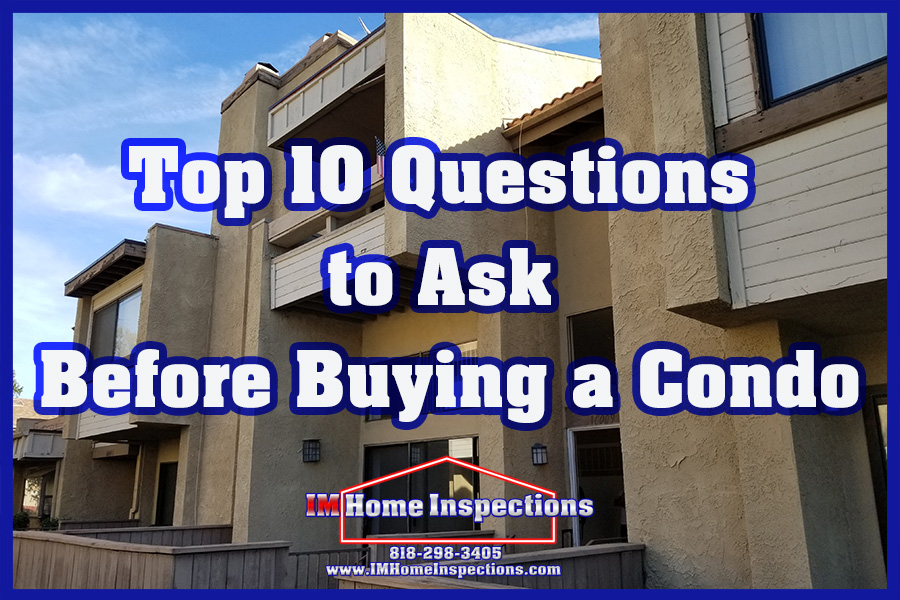
Top 10 Questions to Ask Before Buying a Condo!
When buying a condominium, there are many things to consider beyond the condition of the unit itself. In fact, there are dozens of questions you should ask before purchasing a condo, and many of them have to do with understanding what you’re responsible for and what the Homeowners Association (HOA) is responsible for.
One of the biggest misconceptions about condominium ownership is that the HOA takes care of everything outside your unit. While that may be true in some cases, every HOA operates differently. Something that is the association’s responsibility in one building may be the individual homeowner’s responsibility in another.
Before purchasing a condominium, it’s important to understand exactly what you’re buying and what responsibilities come along with it. Understanding ahead of time what the HOA controls will help you know what IS and what might not be included in a condo inspection.
To help you get started, here are 10 questions worth asking before buying a condo.
1. Does the Unit Have Its Own Hot Water Source?
In some condominiums, each unit has its own individual water heater that you, as the owner, are fully responsible for maintaining and replacing. Other condos have a central boiler or hot water system maintained by the HOA.
The advantage of an HOA-maintained system is that you generally don’t have to worry about maintaining or replacing your own water heater. The downside is that when the building’s boiler goes out, you have little direct control over how quickly it gets repaired.
It’s also important to understand whether the cost of hot water is included in your monthly HOA dues or billed separately.
2. Does the Unit Have Its Own Heating and Air Conditioning?
One of the interesting differences between single-family homes and condominiums is the variety of heating and air conditioning systems we encounter.
In many smaller condominium complexes, each unit has its own heating and air conditioning equipment. In larger buildings, particularly high-rises, the building may have a central heating and cooling system that serves multiple units. Some condos have a hybrid approach where the individual unit has its own heating/cooling device, but it’s connected to an HOA fuel system. Many condos have individual units that are located together on the roof. Ask if such units are accessible.
But there are no hard-and-fast rules. Every condominium is different.
Before buying, find out who is responsible for maintaining the system, who pays when something breaks, and whether you’ll have access to the equipment when repairs are needed.
3. Who Is Responsible for Maintaining the Building’s Exterior?
Unlike a single-family home, where the homeowner is generally responsible for maintaining the exterior, condominium buildings often have shared responsibility for exterior maintenance.
This can include stucco, wood siding, brick, exterior paint, trim, and other building materials.
In some associations, the HOA is responsible for all exterior maintenance. In others, individual owners may be responsible for certain components.
And just because the HOA is responsible for maintaining the exterior doesn’t mean the expense won’t eventually affect you. Major repairs can result in increased monthly dues or special assessments.
Ask who maintains the exterior, when it was last repaired or painted, and whether any major projects are planned.
4. Who Is Responsible for the Windows and Exterior Doors?
This one surprises a lot of condominium buyers.
You might assume that because a window or exterior door is part of your unit, you’re responsible for it. Or you might assume that because it’s part of the building’s exterior, the HOA takes care of it.
Either assumption could be wrong.
Some HOAs are responsible for maintaining and replacing exterior windows and doors. Others place that responsibility entirely on the homeowner. Still others have rules about which portions of the window or door are the owner’s responsibility.
Even when owners are responsible for replacement, the HOA may have strict requirements regarding the style, color, and type of windows or doors that can be installed.
Before purchasing, find out who pays for repairs and replacements, and whether HOA approval is required before making changes.
5. Who Is Responsible for Maintaining and Replacing the Roof?
If you’re buying a condominium on the top floor, the condition of the roof is probably something you should be particularly interested in. But even if you’re on the ground floor, roof maintenance can affect you financially.
In many condominium buildings, the roof is maintained by the HOA. However, that doesn’t necessarily mean you won’t be paying for it.
Replacing a roof can be expensive, especially in a large condominium complex. If the association hasn’t adequately planned and saved for that expense, homeowners may face a special assessment.
Ask when the roof was last replaced, whether there have been recurring leaks, and whether any roof repairs or replacement projects are planned.
And remember, even if the HOA is responsible for repairing a leaking roof, that doesn’t automatically answer who is responsible for damage to the interior of your unit.
6. Who Is Responsible for the Building’s Plumbing?
This is one of the most important questions you can ask when buying a condominium.
In a single-family home, the plumbing system generally serves one property. In a condominium, plumbing systems can be considerably more complicated.
Your unit may have its own water supply piping and drain connections, but those pipes often connect to larger systems shared with other units.
For example, several condominiums may share a common sewer line. Even if every toilet, sink, and shower in your unit is functioning perfectly, a blockage in the building’s shared sewer system could cause sewage to back up into your home.
The same is true of water supply piping. A leak in a shared pipe could affect several units, even if the problem originates somewhere outside your unit.
Before purchasing, find out who is responsible for maintaining and repairing the water supply piping, drain lines, sewer lines, and other shared plumbing systems.
Don’t assume that every pipe inside your walls belongs to you, or that every pipe outside your walls belongs to the HOA.
7. If a Pipe Breaks, Who Pays for the Damage?
This question is closely related to the previous one, but it’s important enough to deserve its own discussion.
Imagine a water pipe breaks inside a wall and floods your condominium. The HOA may be responsible for repairing the pipe itself, but who pays to replace your damaged flooring, drywall, cabinets, or personal belongings?
The answer isn’t always straightforward.
Depending on the HOA’s governing documents, insurance coverage, and circumstances surrounding the leak, the responsibility for repairing the pipe may be different from the responsibility for repairing the resulting damage.
And what happens if the upstairs neighbor leaves a bathtub running and floods your unit?
These situations can become complicated very quickly.
Before purchasing, understand what the HOA’s insurance covers, what your own condominium insurance should cover, and how the association handles water damage originating from shared plumbing or neighboring units.
8. Who Is Responsible for Patios, Balconies, and Other Shared Areas?
Not every part of a condominium complex fits neatly into the category of private property or common area.
Some condominiums have patios, balconies, porches, stairways, walkways, or other areas that are used exclusively by one or two units but are technically owned or controlled by the HOA.
These are sometimes referred to as exclusive-use common areas.
For example, you may have a private balcony accessible only from your living room, but that doesn’t necessarily mean you’re responsible for maintaining its structural components.
In California, the division of maintenance responsibilities for exclusive-use common areas can be particularly important, and the association’s governing documents should be reviewed carefully.
Ask who is responsible for cleaning, maintaining, repairing, and eventually replacing these components.
Also ask whether there are any restrictions on modifying or improving these areas.
9. Who Is Responsible for Parking Areas and Garages?
Parking is another area where condominium ownership can get complicated.
Some condominiums include individually owned garages. Others have assigned parking spaces in shared garages or parking structures. Still others provide parking spaces that are considered common areas or exclusive-use common areas.
These distinctions can affect your rights and responsibilities.
For example, if your assigned parking space is in an underground garage and water begins leaking through the ceiling, who is responsible for repairing it?
What if the garage door stops working? What if the parking structure needs major repairs?
You should also understand whether your parking spaces are deeded to your unit, assigned by the HOA, or subject to reassignment.
And if you own an electric vehicle or plan to purchase one, ask about the rules and requirements for installing charging equipment.
10. What Major Repairs or Assessments Are Planned?
This may be the most important financial question on the list.
Just because the HOA is responsible for maintaining the building doesn’t mean those repairs are free.
Condominium owners pay for the maintenance of their buildings through monthly HOA dues and, when necessary, special assessments.
An association that has adequately funded its reserves may be well prepared for major expenses such as roof replacement, exterior painting, plumbing repairs, and other large projects.
An association with insufficient reserves may have to increase monthly dues or impose special assessments to pay for those same repairs.
Before purchasing, ask whether the HOA has any outstanding or planned special assessments, major maintenance projects, or known building problems.
Review the association’s reserve study, financial statements, meeting minutes, and other available documents. Your real estate agent can help you understand what documents to request and which questions need further investigation.
A condominium with low monthly HOA dues might sound appealing, but those low dues aren’t necessarily a bargain if the association hasn’t been setting aside enough money for future repairs.
Every Condominium Is Different
The important thing to remember is that there are no universal rules governing which components of a condominium are maintained by the homeowner and which are maintained by the HOA.
Two condominium complexes across the street from each other may have completely different maintenance responsibilities.
Before purchasing, take the time to review the association’s Covenants, Conditions, and Restrictions (CC&Rs), maintenance policies, financial information, and other governing documents.
Don’t simply assume that because something is located outside your unit, the HOA will take care of it.
It’s also important to understand that owning a condominium means owning a home within a larger property. Problems with shared plumbing, roofing, drainage, neighboring units, and other building components can affect your home even when those components are outside your direct control.
A home inspection is an important part of the buying process, but it is only one part. Understanding the condition of the larger building, the financial health of the HOA, and your individual maintenance responsibilities requires additional research. In addition, it is important to understand why common areas are typically not part of a home inspection.
The more questions you ask before buying a condo, the fewer surprises you’re likely to encounter after moving in.
IM Home Inspections provides condominium inspections throughout Los Angeles and Ventura Counties. Our inspections focus on the accessible components of the individual unit within the agreed scope of the inspection. HOA-owned common areas and shared building systems are generally outside the scope of a standard condominium inspection.
Book your inspection by calling 818-298-3405 or book online here.